Praying with the Religions of the World and Prayers for Peace in Each Country
After the various opening remarks, Yuka Saionji introduced the central portion of the ceremony program. At the core of the SOPP is the act of joining in peace prayers from various faiths and spiritual traditions. This year at Fuji Sanctuary, prayer leaders from six world religions offered prayers for peace, followed by a prayer from Byakko Chairperson Masami Saionji.
In a change from previous years, the prayers for peace in each country—the SOPP’s other core component—were combined and integrated with the religious prayers. Following each prayer leader’s presentation, the same prayer leader led participants in praying for peace in a set group of countries, as the flags of those countries were presented on stage by flag bearers.
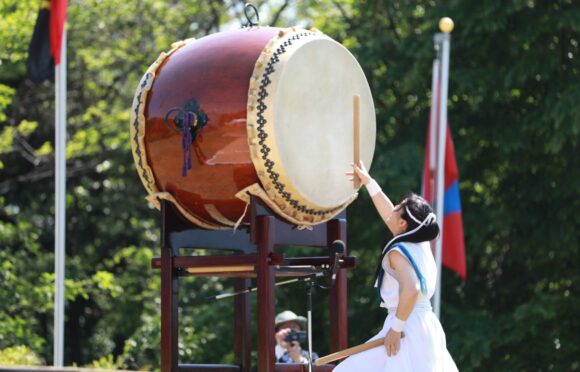
To open and close this portion of the program, Ms. Yoshiko Harada, a musician from Fukuyama, Japan, gave a wadaiko(Japanese drum) performance. She played the ôdaiko, a very large and powerful-sounding drum struck with large wooden sticks. As Ms. Harada moved through various rhythms, the vibrations of the drum resonated throughout the otherwise silent Prayer Field, setting a solemn tone for the prayers. Following Ms. Harada’s first performance, the first prayer leader was introduced on stage.
Mr. Shinjo Nohara (Buddhism)
Abbot of Soto-Shu Kaizozan Ryuunji Temple
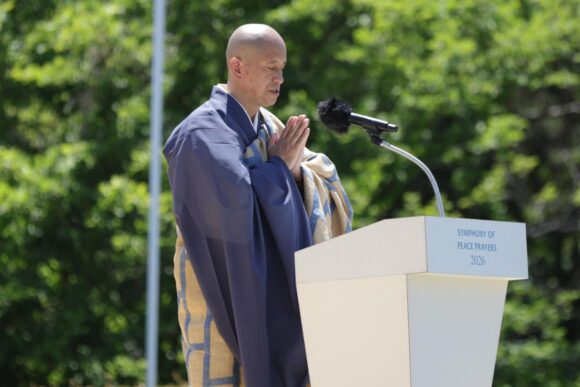
Prayed by Mr. Nohara in Japanese
Avalokiteshvara Bodhisattva, when deeply practicing prajna parami ta, clearly saw that all five aggregates are empty and thus relieved all suffering. Shariputra, form does not differ from emptiness, emptiness does not differ from form. Form itself is emptiness, emptiness itself form. Sensations, perceptions, formations, and consciousness are also like this. Shariputra, all dharmas are marked by emptiness ; they neither arise nor cease, are neither defiled nor pure, neither increase nor decrease.
Therefore, given emptiness, there is no form, no sensation, no perception, no formation, no consciousness; no eyes, no ears, no nose, no tongue, no body, no mind; no sight, no sound, no smell, no taste, no touch, no object of mind; no realm of sight… no realm of mind consciousness. There is neither ignorance nor extinction of ignorance… neither old age and death, nor extinction of old age and death; no suffering, no cause, no cessation, no path; no knowledge and no attainment. With nothing to attain, a bodhisattva relies on prajna paramita, and thus the mind is without hindrance. Without hindrance, there is no fear. Far beyond all inverted views, one realizes nirvana. All buddhas of past, present, and future rely on prajna paramita and thereby attain unsurpassed, complete, perfect enlightenment.
Therefore, know the prajna paramita as the great miraculous mantra, the great bright mantra, the supreme mantra, the incomparable mantra, which removes all suffering and is true, not false. Therefore we proclaim the prajna paramita mantra, the mantra that says: “Gate Gate Paragate Parasamgate Bodhi Svaha.”
Prayed by all participants in Japanese
Fuekô (Universal Transference of Merit):
May this merit extend universally to all, so that we together with all beings realize the Buddha way.
Mr. Nohara’s prayers were followed by prayers for peace in 28 countries (Afghanistan through Burundi).
Mr. Masahiko Dobashi (Shintoism)
Chief Priest at Hitoana Sengen Shrine
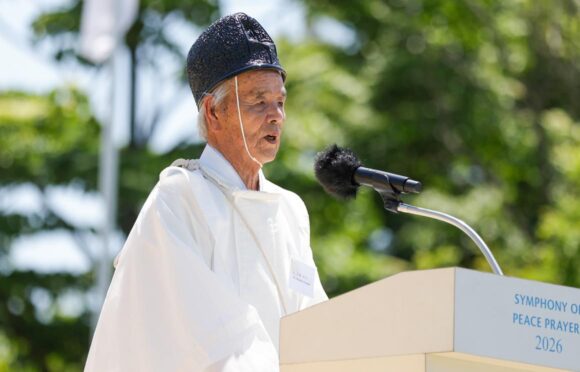
Prayed by Mr. Dobashi in Japanese
In the presence of the deity Konohanasakuya-hime-no-Mikoto, enshrined here in Hitoana Sengen Shrine, Fujinomiya City, Shizuoka Prefecture, I, Masahiko Dobashi, the Chief Priest, offer these words of prayer.
In May of the year 2026 (the 2,686th year of the Imperial Era), we offer our deepest prayers for the Symphony of Peace Prayers event, organized by Byakko Shinko Kai, to be held here at the foot of Mount Fuji.
On December 8, 1941, following the attack on Pearl Harbor in Hawaii, the Japanese military entered the Greater East Asia War (also known as the Pacific War or Asia-Pacific War). Consequently, the Kamiide Juvenile Tank School was established just seven kilometers south of this Hitoana neighborhood. The daily intensity of military drills, with tanks roaming the land and live ammunition being fired from cannons, made it impossible for the people of Hitoana to continue their daily lives.
By military order, the residents were forced to evacuate and relocate to villages such as Kamiide and Shiraito. During this time, the Hitoana Sengen Shrine was also moved to the Shibayama area of Kamiide.
Although the Greater East Asia War ended on August 15, 1945, its impact remains: today, the First Neighborhood Association of Hitoana consists of only about twenty households. Despite these hardships, Hitoana Sengen Shrine continues to serve as the guardian shrine (Ujigami) for the residents of the Hitoana district, upholding our sacred rituals and traditions. In 2013, the Hitoana Fujiko Ruins, located within our shrine grounds, were designated as a component part of the UNESCO World Cultural Heritage site of Mount Fuji. Since then, the shrine has been restored, and we now welcome many visitors and pilgrims.
On this day, as the Symphony of Peace Prayers is held here in Hitoana, we pray that all people—from Japan and every nation across the globe—may live in harmony, find inner peace, and walk hand-in-hand together. As we declare our commitment to world peace for generations to come, we pray for the divine protection of the various deities of Japan. May this gathering flourish ever more grandly and bring a lasting resonance of peace to the entire world.
Prayed by all participants in Japanese
Cleanse and purify us.
Protect and bless us.
Mr. Dobashi’s prayers were followed by prayers for peace in 28 countries (Cabo Verde through Estonia).
Mr. Mark N. Zion (Judaism)
Associate Professor at Tama University School of Global Studies

Prayed by Mr. Zion in English and Hebrew
“My mission on earth is to recognize the void—inside and outside me—and to fill it.”
— Rabbi Menahem-Mendl
Hear, O Israel: The LORD our God, the LORD is one. Love the LORD your God with all your heart and with all your soul and with all your strength. These commandments that I give you today are to be on your hearts. Impress them on your children. Talk about them when you sit at home and when you walk along the road, when you lie down and when you get up. Tie them as symbols on your hands and bind them on your foreheads. Write them on the doorframes of your houses and on your gates.
Devarim The Sh’mah
Prayed by all participants in Hebrew
I have set Hashem always before me.
I have set YudHeahWevHeah always before me.
With Eternal Love You Have Loved Us!
With Eternal Love!
Mr. Zion’s prayers were followed by prayers for peace in 28 countries (Eswatini through Jamaica).
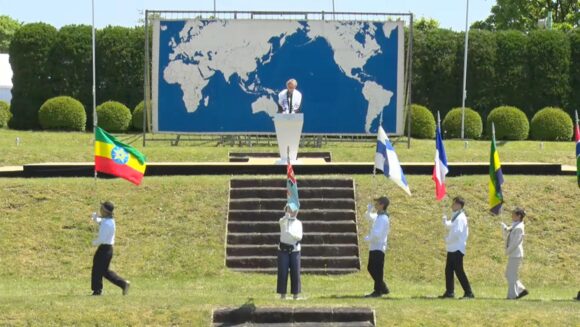
His Excellency Francisco Escalante Molina (Christianity—Catholicism)
Apostolic Nuncio; Ambassador of the Holy See to Japan
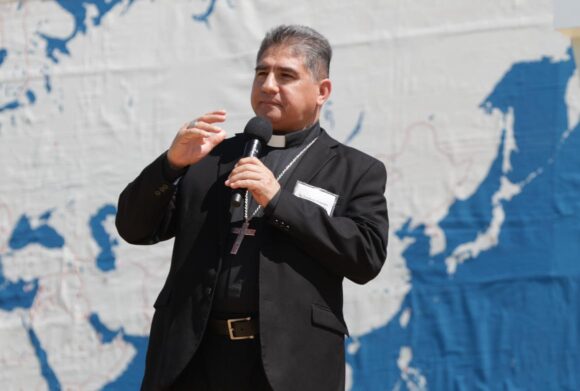
Prayed by His Excellency in English
Heavenly Father! God and loving Creator of all, we praise you for your Glory, for your unconditional kindness and mercy for us, your children!
You, who shine the rays of the sun and send down the rain upon both the good and the bad (cf. Mt 5:45), teach us to follow Your way!
You, who have put Your Divine Spark in the heart of every Woman and Man, blow away the dust and ashes which have settled on hearts, causing them to see only their own interests; re-enkindle the fire of Your love, that we may walk along the path of peace and live as a family, as you created humanity to be.
In every heart, you have placed your law, which we—women and men of all religions—have expressed throughout the ages as the Golden Rule: Do to others as you would have them do to you (Luke 6:31).
Loving Father, we are living a moment of darkness, with wars and so much hatred. Give us the strength to dialogue notwithstanding our pain; melt away the tensions among peoples and countries; open us all to forgiveness and reconciliation.
Use each one of us here today as an instrument of Your peace, as we join our hearts and voices with the same desire of lasting peace and harmony on Earth. Amen.
Prayed by all participants in English
Loving God, make us instruments of your peace and harmony, that we may bring your love to all!
His Excellency’s prayers were followed by prayers for peace in 28 countries (Japan through Micronesia).

Mr. Aijaz Ahmad Dar & Mrs. Sabiha Iqbal (Islam)
Muslim Chaplaincy Team at the University of Roehampton, London, UK
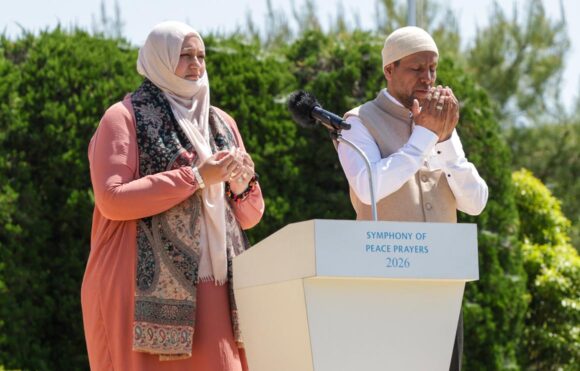
Prayed by Mr. Dar and Mrs. Iqbal in English
I seek refuge with God from Satan the accursed. In the name of God, Most Gracious, Ever Merciful.
Greetings! Peace and blessings of God be upon you All.
Our message today to share with you as our brothers and sisters is that Islam means peace. Muslims believe ‘As-Salam’ is in fact a name, an attribute of God, and it means the Source of Peace. Allah is the name Muslims use for God.
Divine knowledge is contained in the Holy Quran, which Muslims believe to be the book containing the direct word of God Almighty for all of humanity.
In Chapter 5 Verse 4, Allah says; ‘This day have I perfected your religion for you and completed My favour upon you and have chosen for you Islam as religion’.
Islam offers peace, teaches peace and propagates peace. Today, we humbly want to share with you all, three gifts for peace. These gifts are prayers; to enable societal peace, peace in the home and perhaps the most important of them all, inner peace. We believe peace starts from within and then spreads to the world.
- Greeting for peace (offer)
God says in the Holy Quran (Chapter 24: V 62): “When you enter houses, salute your people with greetings of peace – a greeting from your Lord, full of blessing and purity”.
Assalamo alaikum! [Peace be upon you!]
Wa’alaikum Assalam! [And peace be upon you!]
- Gratitude for peace (teaching)
When sitting after prayer, the Messenger of God, the Holy Prophet Muhammad (peace and blessings of God be upon him) used to recite a prayer: “O our Lord! You are (the Source of) Peace. And true peace comes from You. Blessed are You, O Lord of Majesty and Bounty”.
- Guidance for peace (propagation)
The founder of the Ahmadiyya Muslim Community, Hadrat Mirza Ghulam Ahmad, the Promised Messiah and Reformer of the Latter days (on whom be peace) wrote in his final book (25 May 1908) called ‘A Message of Peace’: “A religion which does not inculcate universal compassion is no religion at all. Similarly, a human being without the faculty of compassion is no human at all”.
Justice, kindness, mercy and true love for one another, these are the foundations, the golden principles for universal peace. Love for all and hatred for none.
A final prayer we will share is one the Promised Messiah (on whom be peace) who used to say: “O Ever Living and Self Subsisting One (God), I supplicate for Your mercy. Indeed, my Lord is the Lord of the heavens and earth”.
Aameen. Peace and blessings of God be upon you All and may peace prevail on earth!
Prayed by all participants in Arabic
“Verily, it is in the remembrance of Allah that hearts can find comfort (peace)”.
— Holy Quran, Chapter 13, Verse 29
Mr. Dar and Mrs. Iqbal’s prayers were followed by prayers for peace in 28 countries (Moldova through Qatar).
Mr. Krishnan Unnikrishnan (Hinduism)
Story Weaver in Service of Sanātana Dharma
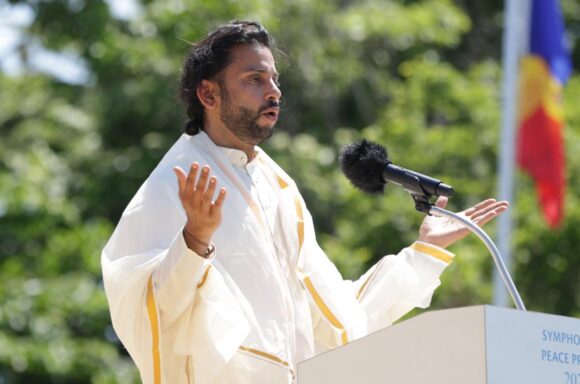
Prayed by Mr. Unnikrishnan in Sanskrit
(Poetic translation)
Om.
May the obstacles among us be gently removed.
May wisdom, sacred speech, and true learning descend among us.
May we meditate upon the divine radiance of the holy light,
and may that light illumine our minds.
May it guide us toward the auspicious and the good,
both within us and around us.
May the blessed presence of unconditional love be with us.
Lead us from the unreal to the Real,
from darkness to Light,
from mortality to Immortality.
Peace within.
Peace among us.
Peace through the cosmic forces.
Prayed by all participants in Sanskrit
Om Shanti Shanti Shantih
Peace within.
Peace among us.
Peace through the cosmic forces.
Mr. Unnikrishnan’s prayers were followed by prayers for peace in 28 countries (Romania through Syria).
Lastly, Masami Saionji offered an original poem about the Divine Spark IN. After her poem, she invited all participants to join in forming the Divine Spark IN.
Prayed by Mrs. Saionji in Japanese
When we perform the Divine Spark IN, the divine spark within each person comes newly alive.
Transcending culture, ethnicity, ideologies, and all differences, all of humanity is reunited through our divinity.
In that moment, inner love and wisdom burst forth, and everything is transformed into light.
Without being taught or guided by others, each person draws forth their own inner divine spark, and the rebirth of all human beings unfolds, one after another.
All lives are united as one, and all existences are transformed into light.
When we perform the Divine Spark IN, all of humanity and all living beings are illuminated by divine light, and the brilliance of life is reborn.
At that time, the universe overflows with the resonance of joy, and a new symphony of life spreads throughout the cosmos.
The creation of a new Earth begins, and all of humanity is united as one.
At this point, Yuka Saionji and Byakko Vice Chairperson Rika Saionji joined Masami Saionji on stage, to lead participants in forming the Divine Spark IN.
First introduced to the public in 2018, the Divine Spark IN (pronounced ‘een’) is like a wordless prayer, comprised of a precise combination of hand and arm movements and deep, peaceful breathing, which helps us to attune ourselves to the sacred being that resides within us. It is easy to learn and practice, enabling us to recall and reconnect with our inner divine nature and contribute to building a peaceful world.
The IN was performed in silence, after which participants were invited to pray May peace prevail on Earth three times (in Japanese).
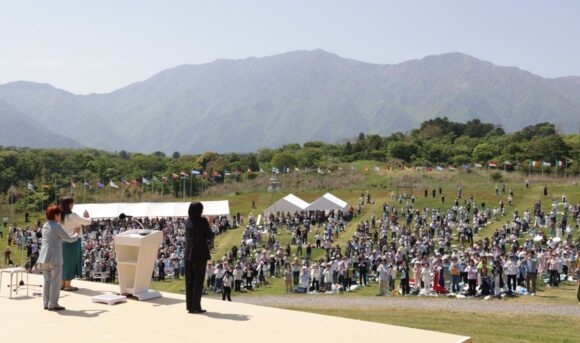
Ms. Saionji’s prayers were followed by prayers for peace in the remaining 25 countries (Tajikistan through Zimbabwe) and for “all the other regions of the world,” represented by the Earth flag.
To close this portion of the ceremony, Ms. Yoshiko Harada returned on stage for a second wadaiko performance. Her ten-minute performance began slowly and softly, weaving through various tempos and volumes before gradually building to a rhythmic crescendo. Both sonically and visually, Ms. Harada’s performance embodied the swell of energy generated at the Symphony of Peace Prayers.